
Day Shall Come Again
Providence and Tragedy in Tolkien's Children of Húrin

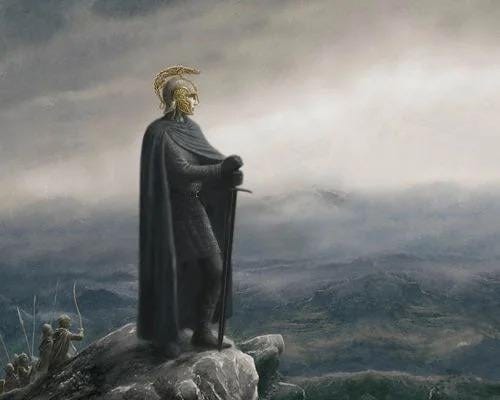
“Last of all Húrin stood alone. Then he cast aside his shield, and seized the axe of an orc-captain and wielded it two-handed; and it is sung that the axe smoked in the black blood of the troll-guard of Gothmog until it withered, and each time that he slew Húrin cried aloud: ‘Aure entuluva! Day shall come again!’ Seventy times he uttered that cry; but they took him at last alive, by the command of Morgoth, who thought thus to do him more evil than by death.”
From Chapter II of The Children of Húrin
I have long struggled with the story of The Children of Húrin from Tolkien’s Silmarillion. It is one of the Great Tales of Middle-earth, alongside the tale of Beren and Lúthien and The Fall of Gondolin. The Children of Húrin is incongruent with the rest of Tolkien’s legendarium; and a new reader, first picking up The Silmarillion, will often be struck at how dark the tale is. The story has no eucatastrophe, and certainly no happy ending. It is a tragedy of the same order as Oedipus, the story of the Volsungs, or any Shakespeare play. However, I hope to show in this essay that this story only reads this way if it is read from the perspective of Húrin and his children. If one takes the perspective of providence, then it becomes one of Tolkien’s clearest meditations on tragedy and providence.
The story begins at the Battle of Unnumbered Tears, where all the hosts of Beleriand unite but are defeated. Húrin is captured as he defends Turgon’s escape to Gondolin. Morgoth curses his family and forces him to watch as his wife and children suffer. It then follows his son Túrin, whose life is plagued by foolish pride, leading to exile, accidental murder of a friend, unknowing incest with his sister, and ultimately, suicide. Only after this is Húrin released, with his house extinct, and forced to wander.
The rest of the legendarium certainly has its fair share of woes and despair. The Akallabêth, Beren and Lúthien, even The Lord of the Rings all have moments of great sadness; but the hope and goodness in them is visible and easy to find. Tolkien has this talent of mixing a sense of loss with his victories and a sense of hope with his defeats. Númenor falls, but the Faithful establish Arnor and Gondor. Mordor is defeated, but Frodo’s wound will not heal. The Children of Húrin, however, has no such sense of triumph and no such sense of hope. Húrin has no descendants, his kingdom is in ruin, and he is left with nothing but the knowledge of how his children suffered. The story feels pagan. On the surface, Túrin has more in common with Oedipus or Sigurd the Volsung1 than with Aragorn or Frodo… on the surface.
With this story, Tolkien sought to tell a tragedy with all the force of Sophocles and all the darkness of the Sagas. But we need not think that tragedy is inherently pagan. A cursory glance at the Old Testament is all you need to see that suffering, death, and despair are part and parcel of the human experience as seen through a Christian lens. The darkness is embedded in the Tale, and we ought not to pretend it’s not there. The Old Testament represents a downward spiral to subjugation and dispersal of the people of God with only glimmers of the Redemption to come. It is only when the story of the Old Testament is put in the context of the salvation which comes in the New that we can see a purpose to all the darkness and suffering. And so, I would submit, we ought to read the story of Túrin this way. Túrin, as a human, views history through a narrow lens; but the hand of providence acts at a larger scale than he can see. The discrepancy between these two perspectives begets tragedy.
Neither Túrin nor Húrin can see how their story ends. The despair that results in Túrin casting himself upon his sword and Húrin casting himself into the sea is a result of their inability to see the hand of Ilúvatar in the course of events. Their brief lives are, in their view, closed off from the rest of history like the narrow view of a camera that has a hard stop at the edges of its pictures, providing no glimpse beyond its limits. But we, as the readers of this great history, have the advantage of seeing how the course of history moves beyond their lives. Húrin’s steadfastness, his faithfulness which he eventually abandons at the end, is the initial domino that leads to the downfall of Morgoth himself. “Morgoth had him chained and set in slow torment; but after a while he came to him, and offered him his choice to go free whither he would, or to receive power and rank as the greatest of Morgoth’s captains, if he would but reveal where Turgon had his stronghold… But Húrin the Steadfast mocked him”. It is for this specific reason that Morgoth curses his house and drives them into despair. Húrin, though he never betrays Turgon, is broken and bereft of hope as he watches his children fall into ruin from the Dark Tower. However, because of his steadfastness, Gondolin’s fall is delayed long enough for his nephew, Tuor to be raised in the elven stronghold and marry Idril, Turgon’s daughter. And from Tuor and Idril springs Eärendil the Mariner, who sails to Valinor on behalf of the Two Kindreds, which ultimately results in Morgoth’s final defeat. Had Húrin yielded, Gondolin surely would have fallen far earlier, preventing the union of Tuor and Idril.
Tolkien thus uses dramatic irony, a classic device in the genre of tragedy, to emphasize the narrowness of Húrin’s vision, as well as Túrin’s. Their vision is obscured by the shroud of the curse of Morgoth, and so they can see no redemption to their suffering. Túrin, blind to the hand of the Valar even in his own life scorns them: “‘The Valar!’ said Turin. ‘They have forsaken you, and they hold Men in scorn. What use to look westward across the endless Sea to a dying sunset in the West. There is but one Vala with whom we have to do, and that is Morgoth…’” Túrin, in his pride and self-will does not help alleviate his own sufferings, often making things worse; but it is hard to claim him as entirely blameworthy for making statements like this one. He is a tragic hero, with all the flaws and sympathy of the great tragic heroes of old. In telling his story, Tolkien reveals the tragic state of human life in all its glory and all its grief. But he also shows us that “day shall come again”, in the words of Húrin. The great irony which begets the tragedy is that Húrin speaks an unwitting prophecy, foreshadowing the Daystar2 who shall sail his ship to the Blessed Realm to petition the gods on behalf of elves and men. However, he cannot see this. Blind to the hand of providence, he can only see the cruel hand of pagan fate which has brought his house to ruin. Neither does Túrin see it. But the reader of the tale sees how providence has acted in them, imbuing their tragic fates with meaning and hope that is invisible to those within the story.
The Children of Húrin is one of Tolkien’s masterpieces, a poignant reflection on tragedy as it arises from our inability to see beyond the scope of our experience. Tolkien sets a classical tragedy in the context of Christian providence and thus transforms it and redeems it. The suffering of Húrin and his children pierces our heart like the cries of Antigone; and, taken alone, it leaves us with the same emptiness. But, when we see beyond the veil of death and take the perspective of providence, the hand of providence is revealed and Húrin’s cry, “Day shall come again!”, blossoms forth in triumph.
Jack Keoseyan is an Orthodox Christian lover of literature and philosophy. He is a software developer by trade and enjoys reading, fly-fishing for trout, and attending his local Orthodox parish. Keep up with him at his Substack and at mythicmindfellowship.com
And Tolkien explicitly makes these comparisons in letter 131.
Eärendil’s name comes from the Anglo-Saxon for the morning star though, in-world, it means “sea-lover”, hence his title as The Mariner.
Great piece, mate. Day shall come again!